
Computer output
As early as the 1980s, Océ developed a digital printer for printing data files generated by large (mainframe) computers such as those from IBM. The output of such computers consisted of alphanumeric characters (letters and numbers) containing information about their relationships. Initially (in the 1960s), this output was mainly printed using automatic typewriters and dot matrix printers on continuous forms.
Electrophotographic copying machines, with their higher speed, offered an attractive alternative. For this purpose, they had to be modified to generate alphanumeric images themselves and project them onto the photoconductor. The software for image formation was executed by a computer, the so-called controller. Such a controller could do little more than form letters and place them in the correct positions. Océ developed the Océ 6750 computer output printer for this purpose, a further development of the Océ 1900 copying machine.
The Océ 6750 was introduced to the market in 1986. In the 6750, a light image was created by a modulated laser beam that was directed at high speed across the charged master. The laser beam was moved by a rotating mirror unit built by the Japanese company Topcon.
Office Automation
The laser printer played a key role in office automation, as office workers’ typewriters were replaced by desktop computers and later by personal computers (PCs, introduced by IBM).
These workstations were connected to the printer via a Local Area Network (LAN), which had been developed in the U.S. in the late 1970s. The LAN rapidly took over the entire office landscape.
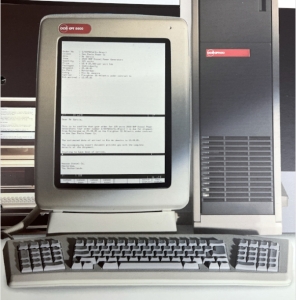
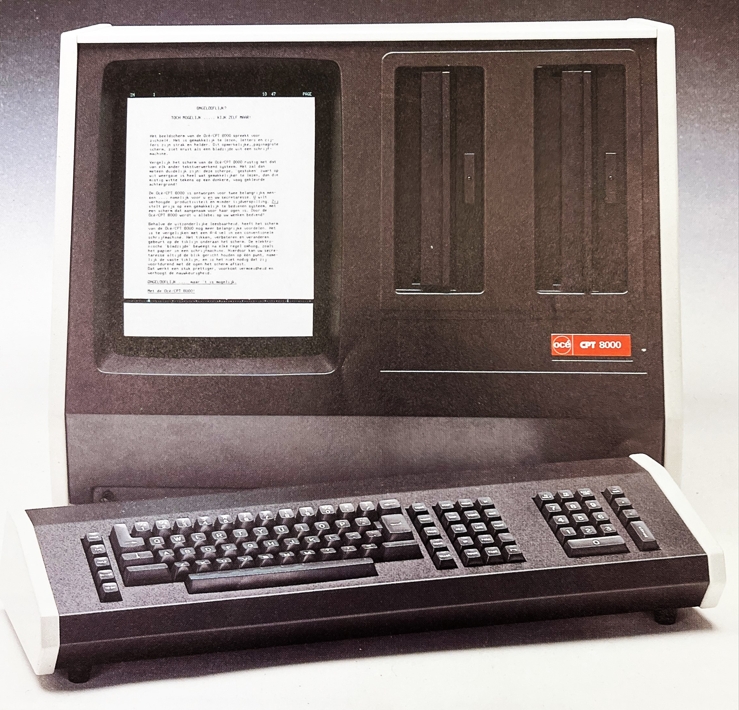 Océ began selling such integrated office systems in 1980, initially featuring workstations, automatic typewriters, line printers, and a server from the American company CPT, under the name Océ CPT 8000 system.
.
.
At the same time, Océ realized that “printing” could eventually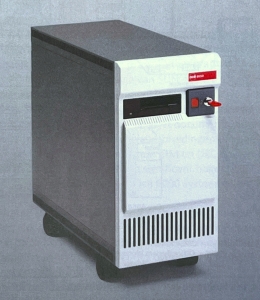
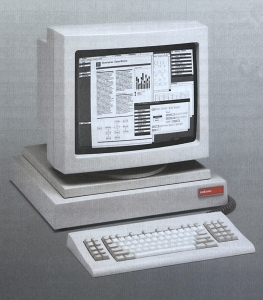 take over the role of “copying” in the future and decided in 1981 to develop its own system. Over the next ten years, Océ worked hard on its own system, the Océ 6000 Office Automation System. Océ made a significant investment in both funds and manpower for this project.
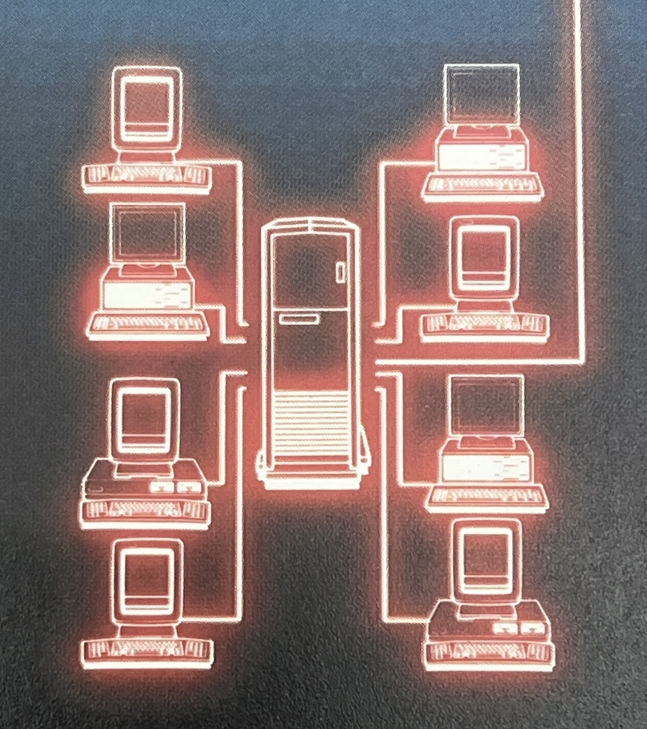 An Océ 6950 workstation (based on a SUN computer) and an Océ 6550 system server were developed for the Océ Office Automation System. The proprietary Océ 6750 was used as the printer. The Océ 6950 was a highly advanced workstation capable of generating both graphics and text.In addition, CPT workstations from the 8000 series and, later, Océ 8200 PCs (based on an Olivetti PC) could be integrated.
.
However, such a complex system, which had to hold its own in a rapidly evolving office market dominated by large companies, proved to be too ambitious for a relatively small company like Océ. After a few commercial placements, development proved unsustainable. The project was discontinued in 1990.
Through its development, however, Océ had gained a great deal of knowledge and expertise in the digital domain, which proved to be of great value in subsequent projects.
The Océ 6750 printer, however, proved to be a success. With numerous connectivity options and versions offering 3 speeds, 4 resolutions, and various output trays and paper bins, this device was marketed as a standalone printer. The first commercial installation took place in 1987, and sales rose sharply in the years that followed.